
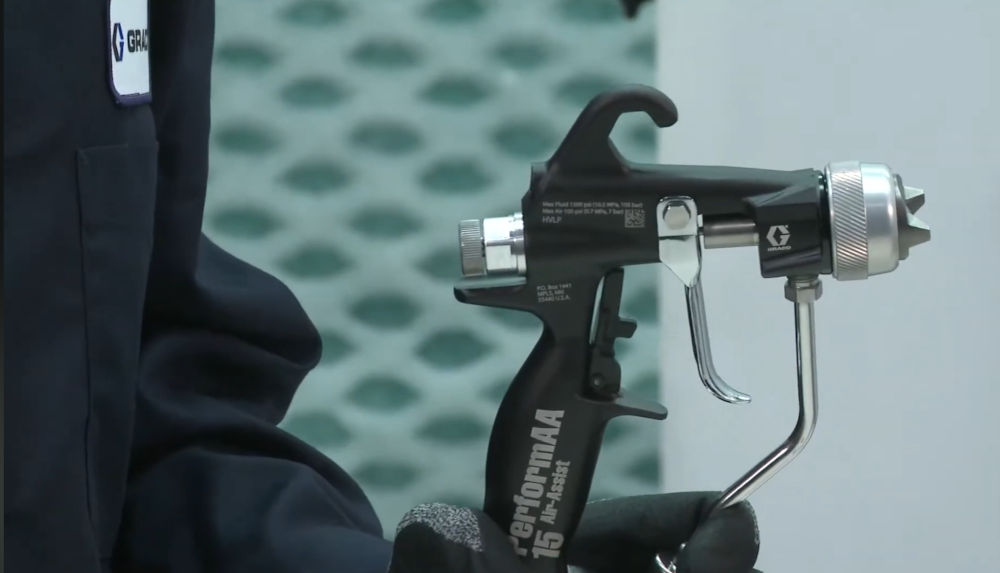

When comparing airless vs air assisted airless sprayers, there’s no “right” answer about which is better. It’s entirely dependent on the application and what type of finish the spray technician is trying to achieve. Overall, standard airless sprayers are often preferred for high-output work, larger surface areas, and coatings that benefit from higher fluid pressure, including many primers, heavy latex paints, and some protective coatings. Air-assisted airless systems are often preferred when the goal is a softer spray pattern, better control, and a higher-quality fine finish on surfaces such as cabinetry, millwork, trim, doors, and furniture. Air-assisted airless is best used as a fine finish sprayer for detailed work like cabinetry. If guided by experts from Bolair Fluid Handling Systems, Air Assisted Airless spray can be used with higher viscosity coatings. Please consult your sales expert at Bolair before attempting. Beyond application, contractors should also consider material compatibility, speed, and their personal operational skills.
Key Takeaways
- Airless and air-assisted airless sprayers serve different purposes, and neither is universally better.
- Standard airless sprayers are ideal for high-output applications, thicker coatings, and projects where speed matters most.
- Air-assisted airless sprayers provide superior finish quality, making them ideal for cabinetry, millwork, furniture, trim, and doors.
- Air-assisted systems generally offer better overspray control, softer spray patterns, and improved transfer efficiency when properly set up.
- Material type should influence equipment selection, some high-viscosity or high-build coatings may be better suited to standard airless equipment, while many air-assisted airless systems are designed for medium- to high-viscosity fluids when properly configured.
- Proper setup, tip selection, and operator technique are just as important as the spray system itself.
Table of Contents
- What Is an Airless Sprayer?
- What Is an Air-Assisted Airless Sprayer?
- Finish Quality: Where Air-Assisted Airless Has the Advantage
- Production Speed and Material Type
- Overspray, Control, and Transfer Efficiency
- When Standard Airless May Be Enough
- When Air-Assisted Airless Is Clearly Better
- Operator Expectations and Setup Skill
- Final Thoughts: Choosing Between Airless and Air-Assisted Airless
- How Bolair Helps Finishers Choose the Right System
- FAQ About Airless vs. Air-Assisted Airless Sprayers
What Is an Airless Sprayer?
An airless sprayer relies on hydraulic pressure from a pump to atomize material at the spray tip. The pump forces paint through the system and out of a small tip. This breaks down the paint stream into droplets, creating a spray pattern that then allows the coating to be applied to a surface.
Compared with air-assisted airless or HVLP fine-finish systems, standard airless sprayers typically deliver higher output and faster coverage, making them well-suited for larger areas and many higher-viscosity coatings such as heavy paints and primers. It can also handle larger jobs that require heavy output, speed, and production.
What Is an Air-Assisted Airless Sprayer?
Air-assisted airless sprayers also rely on hydraulic pressure. However, at the very end of the spray gun, near the nozzle or tip, a small amount of compressed air is added to the stream. This refines atomization and gives more control over the spray pattern. The added air helps complete and refine the spray pattern, reducing tails and creating a softer, more controlled fan.
Finish Quality: Where Air-Assisted Airless Has the Advantage
As mentioned, finish quality is where air-assisted airless sprayers shine. In these types of applications, it’s important for there to be a smooth, blemish-free final result. Air-assisted airless creates a spray pattern with less tailing and a more even fan shape. Because air-assisted airless systems can use lower fluid pressure while adding air to refine the fan, they typically create a softer pattern with less tailing, better control, and less overspray than standard airless systems.
Speed is usually not the only priority with air-assisted airless systems. While standard airless is often the faster choice for broad coverage, air-assisted airless can still provide high production rates while prioritizing a more refined final coat. Cabinetry, door, millwork, and furniture all benefit from this more controlled spray fan pattern.
Production Speed and Material Type
If a spray technician needs a quick application, airless is usually the better option. It works at a higher pressure, so more material comes out of the spray gun each minute. This allows a contractor to cover more surface with each pass, improving their operational output. Standard airless can cover large areas quickly, but proper overlap, tip selection, and pressure adjustment are still important for even film build and finish quality.
Material also affects the choice between an air-assisted fine finish sprayer and a standard airless sprayer. Material compatibility depends on the coating, tip size, filtration, pressure range, and sprayer/gun specifications. Some high-build epoxies and heavy protective coatings may be better suited to dedicated airless equipment, while properly configured air-assisted airless systems can handle many medium- to high-viscosity coatings.
Overspray, Control, and Transfer Efficiency
When looking at airless vs air assisted airless sprayers, air-assisted sprayers are better for overspray control. These spray guns use less fluid pressure since air helps to atomize the material. This results in:
- Softer Spray Patterns: Less fluid pressure means the material comes out finer, reducing harsh lines and thick coatings.
- Better Control: With less pressure, spray technicians have more control over the spray pattern and can focus on fine finish and detail work.
- Less Overspray: Lower fluid pressure and added air help create a softer, more controlled spray pattern, which can reduce bounce-back, spray mist, and wasted material when the system is set up correctly.
When Standard Airless May Be Enough
There are plenty of applications where a fine finish sprayer is unnecessary. Many primers, latex paints, and production coatings are selected for coverage, build, and durability rather than ultra-fine appearance, so a standard airless system may be sufficient when the required finish level is not cabinetry-grade. In these applications, a small amount of overspray may be less critical to the final appearance, but it still affects masking, cleanup, material waste, and jobsite control.
Standard airless is also sufficient for any job where speed and coverage are a priority. High-volume production lines often need to prioritize output rather than high-detail finishes. However, it’s still important to use the right tip and optimize pressure to achieve the highest-quality finish from thicker materials.
When Air-Assisted Airless Is Clearly Better
Air-assisted airless is often the most logical option when the end customer will closely judge the visible finish and the job still requires more production than HVLP typically provides.
For example, a technician will need an air-assist paint sprayer for cabinetry and an air-assist sprayer for millwork. It’s also a good idea for trim packages, high-end interior finishing, and doors. Anywhere that pattern refinement matters, air-assisted is generally the best option. The Graco Merkur air assisted airless sprayer is an excellent product for these types of applications.
Operator Expectations and Setup Skill
An air-assisted fine finish sprayer does not guarantee flawless results by itself. There’s still quite a bit of operator skill that’s involved. Technicians should know the correct distance they need to be from the surface, the speed at which they should make passes, and how much overlap is needed. Setup procedures are equally important. A technician should:
- Prepare the material to spec before application.
- Select the right tip size for the material and desired fan pattern.
- Always test the spray gun and its output before starting production work.
- Set fluid pressure and assist air as low as possible while still achieving a complete, even spray pattern without tails.
Final Thoughts: Choosing Between Airless and Air-Assisted Airless
Choosing between airless and air-assisted airless spraying comes down to the finish standard, coating type, production needs, and job setup. Standard airless sprayers are often the better choice for larger surfaces, faster coverage, and many higher-output applications. Air-assisted airless systems are often preferred when the job requires a softer spray pattern, improved control, and a more refined finish on visible surfaces such as cabinetry, millwork, trim, doors, and furniture.
The best results come from matching the equipment to the coating and application. Tip size, fluid pressure, assist air, filtration, spray distance, overlap, fluid material conditioning and operator technique all affect the final result. If you are unsure which system is right for your work, Bolair can help compare your material, finish expectations, job volume, and budget to recommend the most suitable setup.
How Bolair Helps Finishers Choose the Right System
Deciding between an air-assisted or traditional airless spray gun isn’t always straightforward. Most contractors don’t have the time to sit down and analyze every aspect that’s involved. Even when they do, it can be easy to make mistakes and end up purchasing a spray gun that doesn’t fully perform for the job at hand.
At Bolair, we help technicians choose the right spray system for their application, including the sprayer, gun, tip, hose setup, and accessories. We’ll analyze your finish expectations, job volume, surface type, portability needs, and budget, and then recommend the ideal system. Contact us today to speak with an expert and get guidance on your next purchase.
FAQ About Airless vs. Air-Assisted Airless Sprayers
What is the difference between airless and air-assisted airless sprayers?
An airless sprayer uses hydraulic pressure alone to atomize material. An air-assisted airless sprayer uses hydraulic pressure plus a small amount of compressed air at the spray tip to create a finer, more controlled spray pattern.
Which sprayer produces a better finish?
Air-assisted airless sprayers generally produce a higher-quality finish. They create a softer spray pattern with less tailing and better atomization, making them ideal for cabinetry, furniture, doors, and millwork.
When should I choose a standard airless sprayer?
Standard airless sprayers are best for high-production projects, large surface areas, primers, latex coatings, and other applications where speed and coverage are more important than appearance.
Is air-assisted airless better for cabinetry and millwork?
Yes. Air-assisted airless systems are specifically designed for fine-finish applications where smooth surfaces, minimal overspray, and pattern control are critical.
Do air-assisted airless sprayers reduce overspray?
Yes. Because they use lower fluid pressure and refined atomization, air-assisted airless sprayers typically produce less overspray than standard airless systems.
Can air-assisted airless sprayers handle thick coatings?
Yes, some air-assisted airless systems can handle medium- to high-viscosity coatings when properly configured. However, very high-build epoxies, mastics, and certain industrial protective coatings may require dedicated airless equipment, larger tips, or a different setup. Always confirm coating data sheet requirements and sprayer/gun specifications.
Does an air-assisted airless sprayer require more skill?
Both systems require proper setup and technique. Operators still need to choose the correct tip size, maintain the proper spray distance, use consistent overlap patterns, and test the spray pattern before production work.
Please complete your information below to login.
Sign In
Create New Account